What a Chicago-to-Boston move costs and how long it takes
The short version: Chicago, IL to Boston, MA is about 1,000 miles via I-90, and a long-distance move on this route is priced as a flat rate based on your confirmed inventory, services, and dates — not billed like a local hourly move.
A low number you see online is only useful if it accounts for what changes the work. The biggest variables are how much you're moving, whether you need packing, what floor you're on, and how tight access is on both ends. That's why a real figure comes from a walkthrough of your details, not a route average.
- Estimated cost range: $2,000–$9,000+ for a full-service Chicago-to-Boston move, depending on home size, inventory, packing, storage, access, and move dates.
- Estimated transit window: usually 2–4 days for this corridor, depending on load size, departure timing, weather, and access at delivery.
- Distance: about 1,000 miles via I-90.
To get an exact figure for your move, you can request a free Chicago-to-Boston estimate or call Move and Care at (781) 790-4609.
Chicago-to-Boston moving cost by home size
A studio and a four-bedroom house are nowhere near the same job, so budgeting off a single number is hard. A starting figure that ignores volume, packing, and access doesn't stay accurate for long — it just moves the surprise to the final bill.
Here's how cost generally scales by home size on this route. These are estimate ranges, not fixed prices, and the actual figure depends on what's confirmed during your estimate.
What changes your Chicago-to-Boston price
A few things to know about how the price is built:
- Long-distance moves are priced as a one-time flat rate based on your confirmed inventory, services, and move dates.
- A $50 equipment charge applies, and the confirmed scope should show the equipment charge and any add-ons before move day.
- Basic released-value coverage, at 60¢ per pound per article, is included at no extra cost.
- Full Value Protection is available as a paid upgrade if you want broader coverage.
You can see how our long-distance pricing works for the full structure. When you're ready, get a personalized estimate for your home size — that's the most reliable way to plan for an affordable move rather than guessing from a range.
How many days the 1,000-mile Chicago-to-Boston move takes via I-90
The real question behind transit time is simple: how long will you be without your things? That matters if you have a lease start date, a work deadline, or a family that needs beds the night you arrive.
The route runs about 1,000 miles along I-90, heading east through Indiana, Ohio, Pennsylvania, New York, and Massachusetts before reaching Boston. A typical transit window for this corridor is usually 2–4 days, depending on your shipment size, departure timing, weather, and access at delivery.
A few factors can move that window in either direction:
A committed transit estimate should be part of your written estimate, so you can plan your arrival around a realistic window instead of a best-case guess.
Truck parking permits for your Chicago move-out and Boston move-in
An elevator rule or a parking restriction isn't a problem on its own. Finding out about it when the truck is already double-parked and the clock is running — that's the problem. Both Chicago and Boston have curb-space rules for moving trucks, and the process is different in each city.
In most cases, the customer should budget for parking permits and coordinate them before move day. In Chicago, enforceable CDOT no-parking signs for a professional move are typically handled through the moving company. In Boston, the customer usually applies for the Temporary Street Occupancy Permit unless permit handling is confirmed as part of the move.
Move and Care can advise on access and can provide a Certificate of Insurance (COI) when a Boston building requires one and you supply the details. Plan to arrange permits yourself unless permit support is specifically confirmed as part of your move.
Securing an enforceable CDOT permit in Chicago
Heads up: a "no parking" courtesy sign posted by a ward office in Chicago is not legally enforceable. A car parked in your reserved spot can't be ticketed or towed based on a courtesy sign alone — the signage has to go through the Chicago Department of Transportation to hold up.
Action steps:
- Ask your mover about enforceable CDOT no-parking signs before move-out day.
- Confirm the reserved space covers the truck length your crew will bring.
- Confirm when the official signage must be posted before move day.
- Use the CDOT online permit portal if you need to review Chicago's permit process.
Getting a Boston street occupancy permit for move-in day
Boston requires a Temporary Street Occupancy Permit if you want to reserve curb space for a moving truck on a public street. Without it, your truck can be ticketed or forced to park far from the door. On a move where access affects labor, a long carry can add time and cost.
Action steps:
- Apply for the Boston permit before move-in day to reserve curb space.
- Budget for a $50 base fee, plus space fees and any added signage or metered-space charges listed on Boston's street occupancy permit fee page.
- If you're moving into a managed building or high-rise, ask whether the building also requires a COI.
Why Storrow Drive and Boston's narrow streets need experienced movers
Boston punishes trucks that don't know the city. The most famous example is "Storrowing" — when a tall truck hits one of the low bridges along Storrow Drive, Soldiers Field Road, Memorial Drive, or similar parkways. These roads have low bridge clearances and aren't truck routes. The result can be a damaged truck, damaged belongings, traffic delays, and a move that gets knocked off schedule.
The hazards don't stop there:
- Narrow one-way streets in older neighborhoods where a large truck can't easily turn.
- Brownstone walk-ups with tight staircases and no elevator.
- Tight residential blocks where parking and carry distance become real constraints.
A driver who has run this corridor knows which routes to avoid and how to stage a delivery on a cramped street. Move and Care's crews and Boston-area presence — with offices at 24 School St in Boston and 325A New Boston St in Woburn — mean the destination end isn't being navigated for the first time.
No mover can promise a damage-free move, but local route knowledge reduces avoidable risks before the truck reaches your block.
When to book if you're moving to Boston around September 1st
If your move lands near September 1st, the calendar is working against you. A large share of Boston leases turn over on that date, especially in student-heavy neighborhoods such as Allston and Brighton. The local nickname is "Allston Christmas."
That concentration creates two problems at once: streets clog with trucks and discarded furniture, and movers book out fast. Waiting until mid-August to call for an early-September move often means limited availability.
Practical timing:
- For a late-August or early-September move, book several weeks ahead — roughly 6 to 8 weeks is a safe target for that window.
- Interstate moves with Move and Care require a 2-week cancellation notice to refund a deposit, so confirm your dates before you commit.
- Earlier booking also gives you time to line up both city permits without a scramble.
If your date is anywhere near September 1st, the sooner you lock it in, the more control you keep over your move day.
How to confirm your interstate mover is licensed for a state-to-state move
Coverage and credentials shouldn't become clear only after something goes wrong. Because a Chicago-to-Boston move crosses state lines, it's federally regulated — which gives you a concrete way to check any mover before you hand over a deposit.
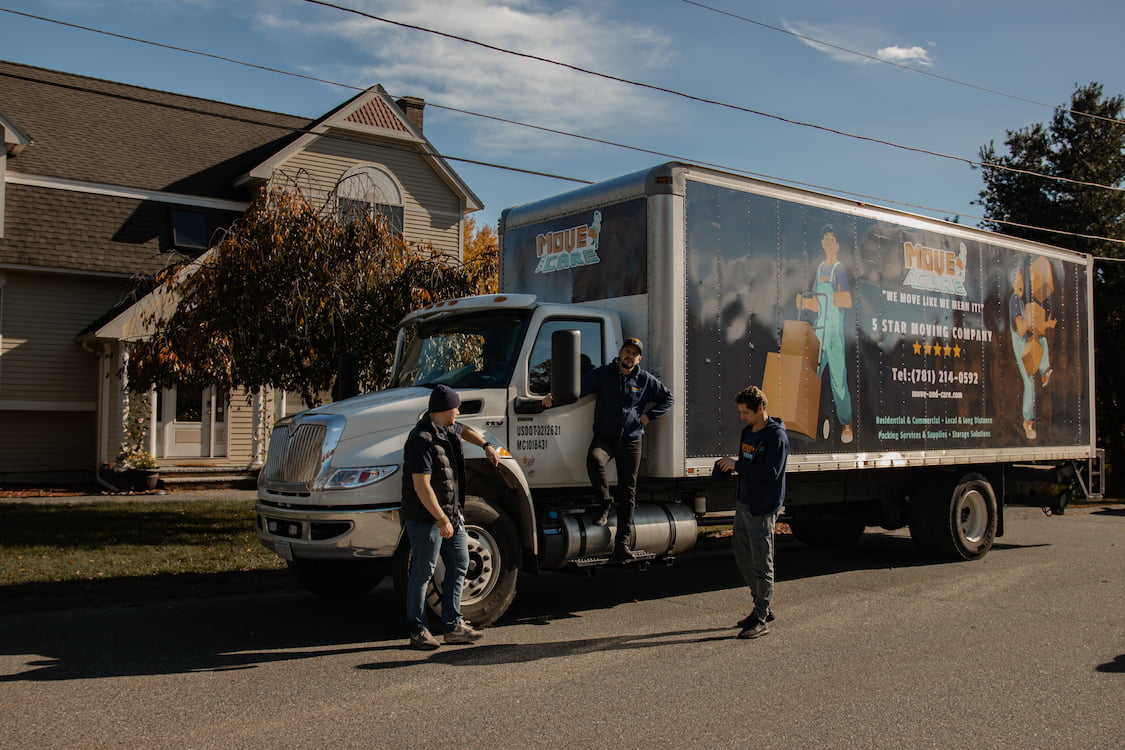
Interstate movers must be registered with a USDOT number and operate under federal interstate moving regulations. You can look up a company's registration and complaint history before booking, which helps separate a real carrier from a broker or an unregistered operator.
Here's how to verify any mover — and here are Move and Care's credentials:
- USDOT #3212621
- MC #1018431
- MA DPU #31854
- NCUC #C-3067
- TXDMV #009636518C
Run any mover's numbers yourself before you sign. A company that hands you its credentials without being asked is making the check easier, not harder.
More About Pricing