
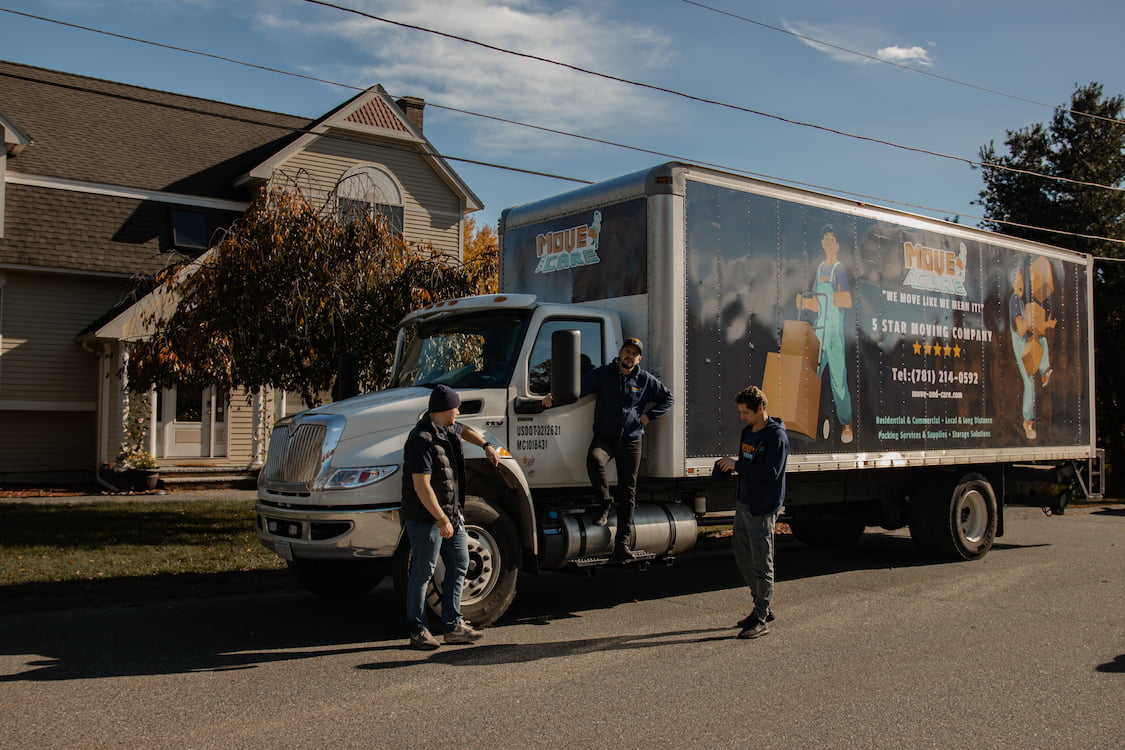
The company that customers love
Move and Care strives to satisfy our client's needs 100%. Our company is well-reviewed, so we are not shy about showing over 2500 reviews of our company in Boston, Austin, San Antonio, Charlotte and Irvine! Explore the reviews and get an idea of our company.
Read Move and Care ReviewsThe company with a reputation
Move and Care has managed to become one of the best moving companies. Our company is based in Boston, MA; Austin, TX; San Antonio, TX; Charlotte, NC and Irvine, CA. We are also very familiar with Chicago and it is part of our area of work.
Check Our Licenses and Awards


Our NYC to Chicago Moving Services

Residential Moving
Service for smooth and easy family moves

Commercial Moving
Smooth business moving to keep the business running

Packing Services & Supplies
Complete packing help and quality materials

Storage Solutions
Safe storage spaces for your items, available anytime

Piano Moving
Skilled piano transport to maintain condition.

White Glove Moving
Moving services with extra care for valuable items

Senior Moving
Gentle and efficient relocations for seniors.
What Customers Say About Us
Influencers who move with Move & Care
Hear how creators and community leaders describe their move-day experience, from booking to the moment every box is in place.
Our Text Reviews
Know Your Moving Cost Today

Why We're a Trusted
moving company from NYC to
Chicago
Choosing Move and Care for your move from NYC to
Chicago means the same crews that run our local moves in
NYC load the truck, and the destination is handled by a coordinator who
has driven the route.
When you choose Move and Care for your move from NYC to
Chicago, you get a moving crew that knows the ins and outs of long-distance moves — from careful packing to
on-time delivery — making the entire process smooth, quick, and safe.
More About us

Fully Licensed & Insured
We are legally authorized to handle moves of any type and distance. Licenses: USDOT #3212621; MC #1018431; NCUC #C-3067; TXDMV #009636518C.

Cost Efficiency
We offer flexible pricing options. Flat rates with a binding moving quote and tailored plans — so you know exactly what to expect with no hidden costs.

Full-Service
We manage everything: careful packing, secure loading, route planning, delivery, and even unpacking at your new house.

Safety
Our movers use professional packing techniques, every truck is GPS-tracked, and insurance coverage is included — so your belongings arrive just as they left.
What you get by moving from NYC to Chicago with us?

Loading and Unloading
We will load into the truck and unload at a new place all of
your items.

Gas, Tolls
Our moving company rates include all the charges, no hidden
fees.

Dedicated Manager
Our dedicated manager will walk you through the whole moving
process.

Transportation
Our Company makes sure all of your belongings are safe during
delivery.

Moving Insurance
Insurance coverage helps save your items from unexpected
damages.

Assemble and Disassemble
We make sure your furniture is Assembled and Disassembled.




Our Licenses & Awards
We’ve helped over 5,000 people move safely — from single-bedroom apartments to 5-bedroom houses and full office moves. Our team has completed more than 1,200 long-distance moves across the U.S., always on time and with belongings protected. With licensed movers, GPS-tracked trucks, and full packing support, we make sure every step of your move is handled with care you can count on.
See Price Estimate

USDOT
3212621
MA DPU
31854
NCUC
C-3067
TXDMV
009636518C







Have Questions?
Ask Professional
How Much Does It Cost to Move from NYC to Chicago?
| Size of the Move | What the Flat Rate Is Built From | Access Factors That Change It |
|---|---|---|
| Studio / Small 1 Bedroom | Inventory list, packing level, distance | Walk-up flights at the New York end; whether a full-size truck can legally reach the Chicago door |
| Large 1 Bedroom / Small 2 Bedroom | Inventory volume, packing materials, protection | COI and freight elevator reservation at either end; Alternate Side Parking hours on the New York block |
| Large 2 Bedroom | Volume, disassembly and reassembly, materials | Long carry from the curb; a Chicago two-flat’s side passage and porch stairs |
| 3 Bedroom Apartment / Townhouse | Volume, packing scope, specialty items | Bungalow attic-level rooms and basement placement; association move window; alley-side access |
| 4 Bedroom or Larger Home | Volume, full packing, specialty and heavy items, storage if the dates do not line up | Booked loading dock; hoisting; winter walkway clearing between December and April |
You receive one flat-rate figure for the entire job. It mostly covers crew, truck, fuel, tolls, transportation, basic insurance and the $50 equipment charge for blankets, dolly and tools. If your building or condominium association requires a COI, we can also prepare one for you.
For the approved inventory and services, your estimate price is set. No extra charges.
Here flat-rate is not a marketing word — it is the way federal rules define a binding estimate. Under 49 CFR Part 375, an interstate mover must physically survey your belongings and provide you with a written estimate. A binding estimate “guarantees the total cost of the move based upon the quantities and services shown.” That’s the paperwork behind the number, and that’s why we look at your inventory before we quote — not after.
If you're asking yourself how much movers cost from NYC to Chicago, the honest answer is that no two shipments on this route are the same price. The estimate is based on volume of inventory, distance, access at both addresses, timing and the services you select. Specialty items are priced separately and published. An upright piano is $160 and a baby grand $240. Items over 200 pounds may incur charges starting at $60. Hoisting is $40 per item per flight of stairs when a piece will not clear a stairwell. Safes, pool tables etc. need the price confirmed for the individual piece.
Packing is quoted separately because the amount of stuff can vary so much from a Manhattan studio to a four-bedroom household. Labor is charged hourly and the materials are per item — small box $6.50, medium $7.50, large $8.50, tape $7 per roll, shrink-wrap $10 per item, mattress cover $17, wardrobe box $28. Most commonly, the two add-ons that affect the total on this route are packing services and storage, especially when a New York lease ends before a Chicago lease begins or a closing date falls. Payment note: card payment – 3.5% processing fee; cash payment – 5% discount.
Want exact moving prices? Request a free estimate — we’ll review your inventory, addresses and access requirements, and then provide you with a formal estimate.
Sample NYC to Chicago Moving Timeline
The 790-mile line haul is dictated by regulation, not traffic. A driver carrying property can only drive for 11 hours after 10 consecutive hours off duty, cannot drive beyond the 14th consecutive hour on duty and must take a 30-minute break after eight cumulative driving hours. This means at least two driving days before any delivery scheduling, and any company promising same-day delivery from New York to Chicago is describing something other than a full household load.
The part that most often runs long is loading day in New York, and the reason has to do with street rules. A commercial vehicle can park on a single block for a maximum of three hours. A single block includes both sides of the street. Double parking next to a parked car is permitted for 20 minutes only for loading, only where parking is not already prohibited, and only when there is no open space or loading zone on the same side of the block. Which curb is actually available that morning depends on the signs on your block and any Alternate Side Parking suspension that may be in effect. We size the crew and stage the carry around those constraints, not find them at 8 a.m.
Truck size matters on the New York end too. The NYC DOT limits a single-unit vehicle, like a box truck, to 35 feet in length, and all vehicles must adhere to the posted capacity or height clearance of any structure on the route. Most NYC parkways – the Belt, F.D.R. Drive, Henry Hudson north of 59th Street, Cross Island and Jackie Robinson – ban commercial vehicles. Getting out of town is a designated truck route network, not the fastest line on a map. Chicago has its own version of this, in the Chicago Municipal Code 9-72-030, which allows the city to designate streets where trucks are prohibited or restricted, and a driver can only enter a posted restricted street “for the purpose of delivering or picking up materials or merchandise and then only by entering such street at the intersection nearest the destination.” CDOT also runs separate Truck Routing and Lake Shore Drive / boulevard travel permits, so the last mile to a lakefront address is a routing decision, not a default.
You will be in contact with the move coordinator so you know when the truck is on the road, when the loading is complete and when the delivery is due in Chicago.
What to Know Before Moving from NYC to Chicago
Both ends of this route are old, dense and renter-heavy, which sounds like a convenient symmetry. It isn’t: the two cities go vertical in completely different ways and the plan has to be built twice.
New York’s housing stock is old and dense. According to the Census Bureau’s 2023 NYC Housing and Vacancy Survey, 54% of the city’s units are in buildings built before 1947, 46% of units are in buildings with an elevator, and 873,600 units (24% of the stock) require one or more flights of stairs to even reach the door. That’s legal, not accidental: NYC Building Code §3002.4 requires at least one elevator in buildings five stories in height or more, so four-story walk-ups are ordinary. That, in practice, means tight door frames, plaster walls that mark easily, narrow stairwells, and hoisting when a sofa or armoire will not turn the landing. At the other end of the spectrum, 22% of NYC units are in buildings with 100 or more units, where the day is dictated by a freight elevator booking and a COI, rather than by the curb. In the historic districts of Brooklyn, a stoop entry and stone sidewalk set the carry distance before the truck arrives.
Chicago's problem is that it has three common types of building and needs three different plans. The two-flat and three-flat is the largest single access category in the city. According to research from DePaul University’s Institute for Housing Studies, 2-to-4 unit properties account for 26 percent of Chicago’s housing stock, with the median age of that stock at 108 years. In a third of Chicago neighborhoods, 2-to-4 unit buildings are the most common housing type, and make up 70 percent or more of residential units in areas like South Lawndale and Brighton Park. More than 76,000 two-unit buildings are listed by the Chicago Architecture Center, which describes the standard form as “an entry porch to one side, and a projecting bay of windows on the other,” with “narrow passageways between closely-spaced structures.” For a crew, that means a second- or third-floor flat reached by a single-file side passage and a porch stair run, with the rear stair often the only route wide enough for a sofa or a mattress.
The second kind is the bungalow. The Historic Chicago Bungalow Association estimates more than 80,000 remain, “nearly one-third of the city’s single-family housing stock,” built in brick between 1910 and the mid-1930s, at “1-½ stories above a full basement” with a “porch with steps ascending from street level.” Nothing enters a bungalow at grade. The half-story is an upper bedroom and is accessed by a narrow, sometimes steep staircase; the full basement is a second stair descent for anything being stored. Those are both decisions to be made before the truck is loaded in New York, as they impact how the load is stacked.
Third is the high-rise, concentrated downtown and along the lake front. According to HUD’s Comprehensive Housing Market Analysis for Downtown Chicago — the Near North Side, Near South Side, the Loop and the West Loop — renters are 63.8 percent of households there and “multifamily buildings with five or more units accounted for 91 percent of all occupied rental units.” So a Loop or West Loop delivery is a dock-and-freight-elevator job, subject to a booked window and a certificate of insurance, not street access. If the building is located in a designated landmark district, alterations to district properties are reviewed by the Commission on Chicago Landmarks, which is a good clue that the original stairs, doorways and finishes are likely still there and worth protecting on the way in.
Chicago’s curb rules are tougher than most arrivals expect. Municipal Code 9-64-170 makes parking “at any time, including overnight, any truck, van, tractor, truck tractor, semi-trailer, trailer… or commercial vehicle… on any residential street within the City” illegal, except where a vehicle “actually and expeditiously being loaded or unloaded” is concerned. Commercial vehicles are “subject to immobilization and impoundment, without prior notice.” The City’s plain-language guide to parking a commercial truck in Chicago adds a constraint that eliminates much of a normally-available curb: a vehicle six feet or taller cannot park “within 20 feet of any crosswalk, alley, commercial driveway or fire lane,” and Chicago residential blocks are cut by alleys. Space is limited, but available. CDOT does have a “Moving Van Parking” type in its Occupy the Public Right of Way permit but the application does ask for an Illinois Commerce Commission vehicle number, which the ICC assigns to movers licensed for moves within Illinois — a different authority than the federal one that oversees an interstate haul. Residents can also pick up No Parking signs for free at their ward service office. In the 44th Ward, for instance, signs “must be picked up and posted AT LEAST 48 HOURS IN ADVANCE OF THE MOVE” and are valid for an eight-hour window. They are explicitly “non-enforceable” and are trumped by street cleaning signs, which “take precedence over Moving Signs.” Enforceable signs are $25 thru CDOT and limited to eligible moving companies. No moving pods and containers of any kind are permitted on the public way. Many blocks are also in a residential parking zone that corresponds to the City Sticker zone number.
Then there is winter, which on this route is a scheduling input, not a talking point. Chicago’s 1991–2020 normals show the average annual snowfall is 38.4 inches, most of which falls in January (11.3”) and February (10.7”). The normal high in January is 31.6°F, with a normal low of 18.8°F. The city’s response to that has a direct bearing on a moving truck: the Winter Overnight Parking Ban covers 107 miles of arterial streets from 3 a.m. to 7 a.m., from December 1 to April 1, “regardless of snow,” with towing starting at a minimum of $150 plus a $60 ticket and $25 daily storage. A separate Two-Inch Snow Ban spans about 500 miles of main streets and “can be activated after there are at least two inches of snow on the street, no matter the time of day or the calendar date.” A December-to-March delivery demands an earlier start, cleared and salted walkways, floor protection against snowmelt and road salt, and a route that considers the ban arterials. The countervailing pressure comes in late summer, when the arrival of students tightens the calendar. DePaul’s general fall quarter move-in is Saturday, September 5, 2026. UIC houses over 3,600 students in 10 residence halls, with about 1,400 first-year students arriving in a single 9 a.m. to 2 p.m. window.
Got something heavy or large to move? Let us know before you move. You may need extra labor, hoisting or a custom handling plan for a piano, a safe, a pool table, gym equipment or anything over 200 pounds — and between a pre-1947 New York staircase and a century-old Chicago porch stair, that decision is best made a week out, not on the landing.
The Moving Process (NYC to Chicago)
Preparation
We begin by taking your inventory and building a service plan: what’s moving, what needs packing, what the access looks like at both ends, and whether either building requires a COI or an elevator reservation. If you require packing services, full or partial packing will be scheduled before the move day.
What to arrange yourself, especially on this route. For the New York side, ask your managing agent or board three questions off the bat: what the COI needs to say and who needs to be named on it, what days and hours are moves allowed, and if the freight elevator needs to be booked. A late COI can cost you the day. Look for signs on your block that indicate street cleaning hours and a metered “No Standing Commercial Vehicles Only” zone. Commercial vehicles are not allowed to park on residential streets between 9 p.m. and 5 a.m., so the truck can't sit outside overnight before an early start. There are three specific calls to make on the Chicago end. Start with your property manager, condo association or HOA. Ask about a move-in window, loading dock or freight elevator to reserve, gate or fob code, move-in deposit and COI requirement. Illinois condo boards make their own rules for use of common elements, so the building is the only place to look for this, and there’s no one citywide source. Second, call your ward service office at least three days in advance if you want free No Parking signs – they must be posted 48 hours before the move, they are non-enforceable and procedures vary by ward. Third, check whether your block is in a permit parking area for residents. The customer is responsible for both addresses for parking arrangements and any required permits. Clear the walkways and curb area before the crew gets to either end – and in a Chicago winter that means shovelled and salted, including the porch steps – disconnect any appliance hooked to a water or gas line, empty desk and dresser drawers, and label sealed boxes with the destination room. Crews cannot load flammable, explosive, firearm-related, gasoline or propane-filled items.
We will show the final scope clearly on your estimate. Timing and cost can be impacted by packing level, special items and building access.
Moving Day
Furniture is padded and shrink-wrapped, and the load is inventoried and stacked for a two-day haul rather than a cross-town hop – 790 miles of road vibration is a different loading problem, and it is also why the Chicago-end access has to be known before the truck is packed. A piece for a bungalow attic room or a third floor flat is loaded to come off in the right order. You’ll get a copy of the bill of lading before or when you load, which the FMCSA calls the contract between you and the mover for moving your shipment.
The move is federally regulated because it crosses a state line. The two states split it the same way. The New York Attorney General puts it this way: movers are licensed by NYSDOT if the move is entirely within New York, and by the Federal Motor Carrier Safety Administration if the move is between New York and another state. The Illinois Commerce Commission licenses household goods movers for moves within Illinois, but is not the authority for the interstate haul. For your NYC to Chicago move the authority you want is USDOT 3212621 and MC 1018431, and you can check us out in the federal mover database before you sign anything.
Delivery & Unpacking
We unload in Chicago, put furniture in the correct rooms and reassemble standard items. If unpacking was booked we clear away boxes and packing material after the set up. The delivery is intended to be one continuous attended unloading window as opposed to a park-and-start because Municipal Code 9-64-170 permits the truck on a residential street only while it is actively being unloaded, and because between December 1 and April 1 a vehicle cannot sit on a ban arterial between 3 a.m. and 7 a.m. at all.
If there is any damage or loss, report it to the crew immediately and if you can, fill in a Damage Report before they leave. Any damages noted after the move shall be reported within 96 hours.
Basic Released Value Protection is included free of charge and it is worth knowing what it actually covers. FMCSA caps that liability at 60 cents per pound per article and offers its own example: a 25-pound television that is lost or damaged pays $15. Full Value Protection is available for an extra charge and makes the mover responsible for the replacement value of the shipment. The FMCSA’s Rights and Responsibilities handbook states that “the minimum level for determining the Full Value Protection of your shipment is $6.00 per pound times the weight of your shipment.” If you own anything valued above $100 per pound — jewelry, china, furs — it has to be listed specifically on the shipping documents for that coverage to apply, which is a five-minute task worth doing before loading. Regardless of our 96-hour reporting request, federal law protects your right to file a claim with the carrier: under 49 U.S.C. §14706, a carrier cannot set a filing period of less than nine months from delivery. See our reviews and about us for how the process has been described by customers before, or get in touch to chat through your dates.
More About PricingF.A.Q. about moving from NYC to Chicago
Long distance moves are flat rate so the price is not increasing by the hour but rather set for your job. That number is based on the volume of inventory, the distance, the access at both addresses, timing and the services you select. That's why we review your inventory before we quote. In most cases, the rate includes the crew, truck, gas, tolls, transportation and basic insurance, along with a $50 fee for equipment such as blankets, a dolly and tools. Specialty pricing is posted. An upright piano is $160, a baby grand $240, items over 200 pounds may start at $60, and hoisting is $40 per item per flight of stairs. Packing labor is charged by the hour and materials by the item. There is a 3.5% card processing fee. Cash may be subject to a 5% discount.
The drive is roughly 790 miles. The federal rules set the floor. Under FMCSA hours-of-service rules, drivers can be behind the wheel no more than 11 hours after 10 consecutive hours off duty, and they cannot drive into the 14th consecutive hour on duty. They also must take a 30-minute break after eight cumulative hours of driving time. That means the line haul is at least a two-driving-day minimum before any delivery scheduling, so don't expect a same-day New York to Chicago household delivery. You will be given a delivery window ahead of time, and your coordinator will confirm when loading is complete and when the truck is arriving in Chicago. The most frequent overrun is the loading day in New York, typically due to curb access or a building's elevator window rather than the mileage.
Under Chicago Municipal Code 9-64-170, it is illegal to park a truck, van, trailer or commercial vehicle on a residential street at any time including overnight, except while it is actually and expeditiously being loaded or unloaded. Commercial vehicles found in breach can be immobilized and impounded without notice. The City also bans any vehicle six feet or taller from parking within 20 feet of a crosswalk, alley, commercial driveway or fire lane, which eats up more curb than people realize on an alley-cut Chicago block. This is why we schedule delivery as one continuous attended unloading window. Parking arrangements are the customer's responsibility, so check your block's posted signs and verify anything unclear with your ward service office.
There are two ways, both with limits. Your ward service office can provide free No Parking signs for a residential move, but as the 44th Ward publishes, they must be picked up and posted at least 48 hours in advance, they cover an eight-hour window, they are explicitly non-enforceable and street cleaning signs take precedence over them. CDOT enforces signs that allow ticketing or towing and are $25, and are limited to eligible moving companies. And although CDOT's Occupy the Public Right of Way permit includes a Moving Van Parking type, the application does ask for an Illinois Commerce Commission vehicle number. In any case, moving pods and containers cannot be put on the public way. Each ward has its own rules, so check with your own alderman's office.
Stairs, usually more than one flight. According to the Institute for Housing Studies at DePaul, units in 2-to-4 unit properties represent 26 percent of Chicago's housing stock and have a median age of 108 years, and the standard two-flat, as described by the Chicago Architecture Center, includes an entry porch on one side and narrow passageways between closely spaced buildings. Another similarity with bungalows is that the Historic Chicago Bungalow Association estimates there are more than 80,000, nearly a third of the city's single-family stock, built one and a half stories above a full basement with porch steps up from street level. Nothing enters at grade. Tell us the floor and stair type and if there is a rear stair, it changes crew size, protection and how the truck is loaded in New York.
It is workable but it has to be scheduled around real rules. Chicago's normal annual snowfall is 38.4 inches, according to the National Weather Service 1991-2020 normals, mostly in January and February, with a normal January high of 31.6°F. The city's Winter Overnight Parking Ban applies to 107 miles of arterial streets from 3 a.m. to 7 a.m., December 1 through April 1, regardless of snow, with towing starting at a minimum of $150, plus a $60 ticket and $25 daily storage, and a separate Two-Inch Snow Ban can be put in place at any time on approximately 500 miles of main streets. We plan an earlier start, a route that takes those arterials into consideration and floor protection against snowmelt and salt. On your end, make sure to shovel and salt the walkway and porch steps before the crew arrives.

Our Instagram Profile


Contact Us
Fast, Fair Moving Estimate
Clear pricing. Certified pros.
Careful handling.
Start your smooth move with Move and Care.




