


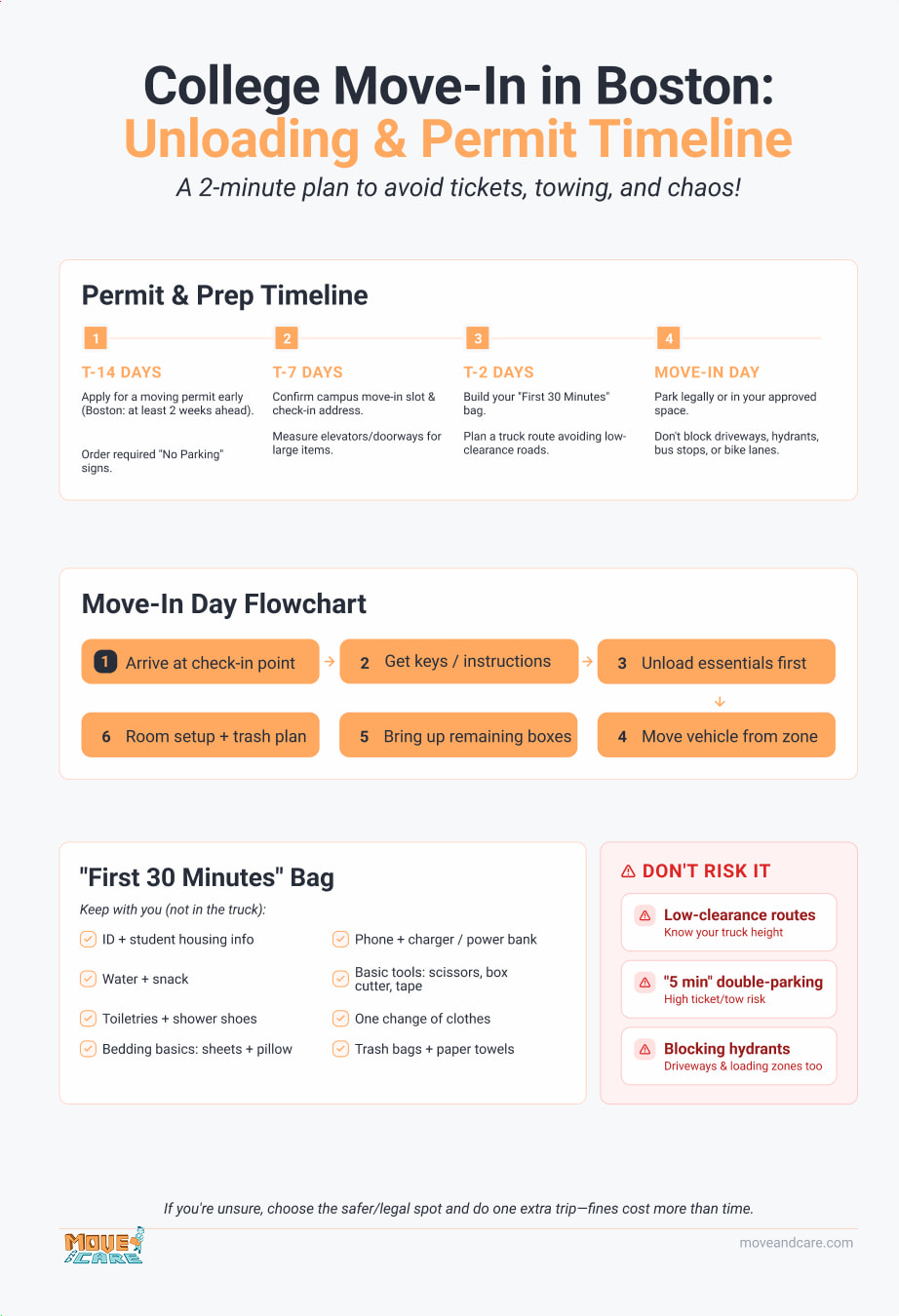
Greater Boston move-in basics that change your checklist
Your list should have two parts if you’re moving into a dorm in Boston or Cambridge: the room layer, which is what you’ll actually use, and the city layer, which is how you’ll unload without making a mess. According to the City of Boston, most leases end at the start of September. The city also says that there may be temporary changes to parking and traffic rules in some areas. That’s important for students who live near school in places like Allston, Fenway, and Mission Hill, where there is a lot of competition to move in and get a curb.
Your path is also important. Boston says moving trucks can’t go on Storrow Drive because there isn’t enough room, and the tallest trucks can’t be more than 10 feet. Before you start the engine of a rented box truck or tall cargo van, plan around this. This is especially important during student move-in week, when traffic is already heavy.
“I am thrilled to welcome new residents and students to the City of Boston,” Mayor Martin J. Walsh (Mayor of Boston, official City statement) said about the move-in.
If you’re also dealing with city permits, here’s what you need to know: Cambridge lets you reserve curb space for a moving van with a street occupancy permit, and both Brookline and Somerville have clear instructions on how to book room and put up signs for moving day. These specifics aren’t “extra.” They can make the difference between a five-minute unload and a 45-minute trouble on a narrow neighborhood street.
University move-in rules in Boston and Cambridge you should check first
The first thing on a “move-in checklist for college” should always be “what your school allows.” As movers, we’ve seen that the most often-thrown-away items are those that are flagged by the housing staff: ovens, items with open flames, and electrical equipment that isn’t safe. Use the information that schools give you because the rules are different even between sites that are close to each other.
For Boston University, start with the official dorm room essentials guide (“What to Bring”). This clearly lists items that aren’t allowed and tells students that they need to rent a MicroFridge to use a microwave and that extension cords aren’t allowed.
Through its vending program, Boston University also makes appliance rules clear. For example, on the college packing list context for dorm appliances, it says that for dormitory-style homes, MicroFridge is the only microwave that can be in the dwelling. That one rule changes what you should bring and what you shouldn’t buy.
For a Boston College move, use the official Boston College move in summary page to see what is allowed and what is not allowed. It lists things that aren’t allowed, like extension cords and switches with more than one outlet. It also suggests useful things, like storage space under the bed and a power strip with an on/off switch.
Before they move in, Harvard students should look at the official move-in process. A Harvard move-in time slot page is made by Harvard College Housing. It tells students how to choose a move-in time slot when the college texts them and how the process works for term move-in. If you want official room rules, you can look at the Harvard Summer School “Your Room” prohibited items list. It has standard dorm bans like candles, incense, and space heaters.
MIT in Cambridge has a useful list of things to bring and a page with thorough instructions on how to move in. The official MIT dorm room essentials page tells students to bring clothes for the weather, like a heavy winter coat and boots for snow. The MIT move-in process page goes over check-in, guest policies, and how to park on campus (which can change from year to year).
Northeastern’s move-in pages are great for making plans for moving. Northeastern’s official move-in instructions say that based on the hall you’re assigned and where you park, you may be asked to unload your things and then move your car. Northeastern also puts out room rules, which include a clear list of electric cooking appliances that can’t be used in standard or suite-style rooms.
The official Tufts banned items policy tells students what they can’t bring to school, including things that have open flames, like candles and incense. The Tufts move-in information page explains how to get your keys and when you can move in.
UMass Boston puts out a useful what to bring to UMass Boston list that includes both things that aren’t allowed and appliances that are. The list includes a reminder to use surge protectors instead of multi-outlet plugs or extension cords.
Dorm room essentials for Greater Boston students
It’s because most students want to feel at home fast that they search for “dorm room essentials.” The safest way to pack is to make sure you can sleep well, take a shower quickly, study comfortably, and store things cleanly. For day one, you don’t need a “perfect” room. By night one, you just need a room that works.
In dorms around Boston, beds are usually Twin XL, and there may not be a lot of outlets. Extra-long twin sheets are recommended by Boston University’s living guidelines, which also list safety rules for power strips, such as the need to plug them directly into the wall instead of chaining them together. Adding these rules to your basics will keep you from having to run to the store at the last minute and will also keep you safe.
Boston weather is important to remember, even if move-in day is hot. MIT tells students straight out to bring snow walking gear like a heavy coat, gloves, a scarf, and boots. That’s how things are in the area: you can get there in the middle of summer and still need winter clothes in a few weeks.
For “what guys need to have in their dorm room” and “what girls need to bring to college,” practice is better than stereotypes. Bring a small gym bag and a way to separate your dirty clothes if you work out a lot. If you do a lot of hair or body care in the morning, bring a small organizer that can fit in a shared bathroom. The best list of things you need is one that looks like a normal morning on campus.
College packing list with a smart buy-or-bring decision table
This is where students pack too much. Boston University makes it clear that you should only bring what you need and try to coordinate shared things with your roommates when you can. The living information for Harvard Summer School also says that dorm rooms are small and that students should bring less than they think they will need because many things can be bought on campus later. This advice is especially useful in Boston and Cambridge, where stores, delivery choices, and working with roommates make it possible to “buy later.”
| Category | Bring on move-in day (must-have) | Bring within 1 week (nice-to-have) | Buy/ship after you see the room (avoid overpacking) |
|---|---|---|---|
| Sleep | Twin XL sheets, pillow, basic blanket/comforter | Mattress topper, extra pillowcases | Extra décor bedding, bulky throws |
| Bath & hygiene | Towel, shower shoes, shower caddy, daily toiletries | Extra storage bins, basic first-aid | Full-size extras you may not store |
| Study | Laptop, chargers, basic supplies | Desk lamp (if needed), folders | Printer (often unnecessary in dorms) |
| Power & safety | Surge protector/power strip that meets dorm rules | Small tool kit (scissors, tape) | Extra cables once you see outlet layout |
| Boston weather | Rain layer, comfortable walking shoes | Heavy winter coat + gloves + boots | Extra winter gear after first cold snap |
When it comes to appliances, this list becomes “local.” Tufts says that individual microwaves are not allowed in student dorm rooms and also bans many other cooking equipment. Northeastern also doesn’t allow microwaves in traditional or suite-style rooms, and Boston University doesn’t allow microwaves unless they are rented as a MicroFridge. Always make sure you know what kind of building you’re going to because some colleges have different rules for apartment-style housing versus regular dorm rooms.
How to pack for college so move-in day stays simple
It’s best to pack by “setup order” instead of random groups if you can only follow one rule. Stage 1: bed and shower; Stage 2: study materials and clothes; and Stage 3: other things. It is important to know this in Greater Boston because there are real move-in dates, lifts are busy, and streets are narrow. Northeastern’s move-in instructions even say that you might have to unload and then move your car, so make sure you have the right boxes on hand first.
Put things in hard bins or small boxes that are safe to carry up the stairs. Write your name, your living hall, and the “zone” (Sleep, Bath, Study, or Clothes) on each box. The move-in instructions at Boston University stress the importance of check-in steps like getting your keys and finishing your registration. Because of this, you might not want to deal with 50 loose bags while you do paperwork.
Also, bring a separate bag for your ID, phone charger, toothbrush, blankets, shower shoes, and one change of clothes. This bag should never be put in the main pile. You can still do your job even if you are late or if your car needs to be moved fast. The story of the Harvard student who packed too much shows that some things are easy to buy here and that some things you might think are fine, like devices that make heat, are not.
Move-in day workflow for dorms and student apartments
If you want to move into a college without a lot of stress, you should plan ahead for the curb. If you’re in Boston during the busy student season, be ready for limits and pay attention to signs. On the city’s move-in preparation pages, it says that during move-in week, big neighborhoods with lots of students, like Allston and Fenway, get extra attention, inspections, and parking changes.
Moving in and having an effect on the neighborhood: Jessica Thomas, Assistant Commissioner for the City of Boston’s Inspectional Services Department, said, “We encourage you to be considerate neighbors by properly disposing of trash and keeping the area clean.”
Check-in flow is another thing you need to think about for room move-ins. Many schools have set check-in times or time slots. For example, Harvard says that students choose their move-in time slots through a process, and Boston College says that students need to sign up for a specific move-in time in order to check into their dorms. With these methods, there is less traffic, so if you arrive after your time slot, you may have to wait.
If you want to move into a student apartment that is not on campus, city permits can be very important. This is popular in Allston, Fenway, Brookline, Somerville, and some parts of Cambridge. Boston says you can reserve a parking spot for moving day, but you have to apply online at least two weeks in advance. Cambridge says that its moving van permits reserve curb space. Somerville says you can reserve a spot with a moving van permit and includes information about fees and signs in its moving-season advice. And Brookline says that police will not honor signs if the rules are not followed.
This is why there are limits: Nick Gove, who is the commissioner of the Boston Transportation Department and deputy chief of streets for transportation, said, “Temporary parking restrictions help keep our streets safe and moving during this busy time.”
Choosing moving help responsibly in Massachusetts
Some students will do a move they made themselves, which can work. But in Greater Boston, where there are stairs, narrow curbs, and tight time slots, professional help quickly becomes useful. Our student movers in Boston page covers dorm and off-campus dates, and the Boston movers page has the September 1 permit rules the whole city moves under. Making smart choices is important. Checks can be made with state and federal agencies, such as state licenses for movers within the state and federal registration tools for movers between states. The City of Boston’s moving guide makes this clear.
The FMCSA says that interstate movers need to be registered with the federal government and have a U.S. DOT number. It also has a website you can use to make sure the mover is registered and see information about complaints and safety. If you’re coming from another state to Boston, this is one of the fastest ways to make sure someone is who they say they are before you sign anything.
In-state movers should have a license from the Massachusetts Department of Public Utilities for moves that only happen in Massachusetts. When you look at different prices, make sure they are all for the same things. This includes stairs, long carry, elevator reservations, parking permits, and time windows.
Last but not least, a quick word about the environment for student apartments: don’t “move out dump” when there is an Allston-style turnover. Boston’s moving tips encourage students to gift or recycle instead of leaving things on the sidewalk, and Somerville also gives advice on how to get rid of things, such as how to use tools like the Waste Wizard and bundle boxes for recycling. For information on how to properly dispose of waste at the state level, visit the Massachusetts Department of Environmental Protection’s (MassDEP) website: MassDEP.




