
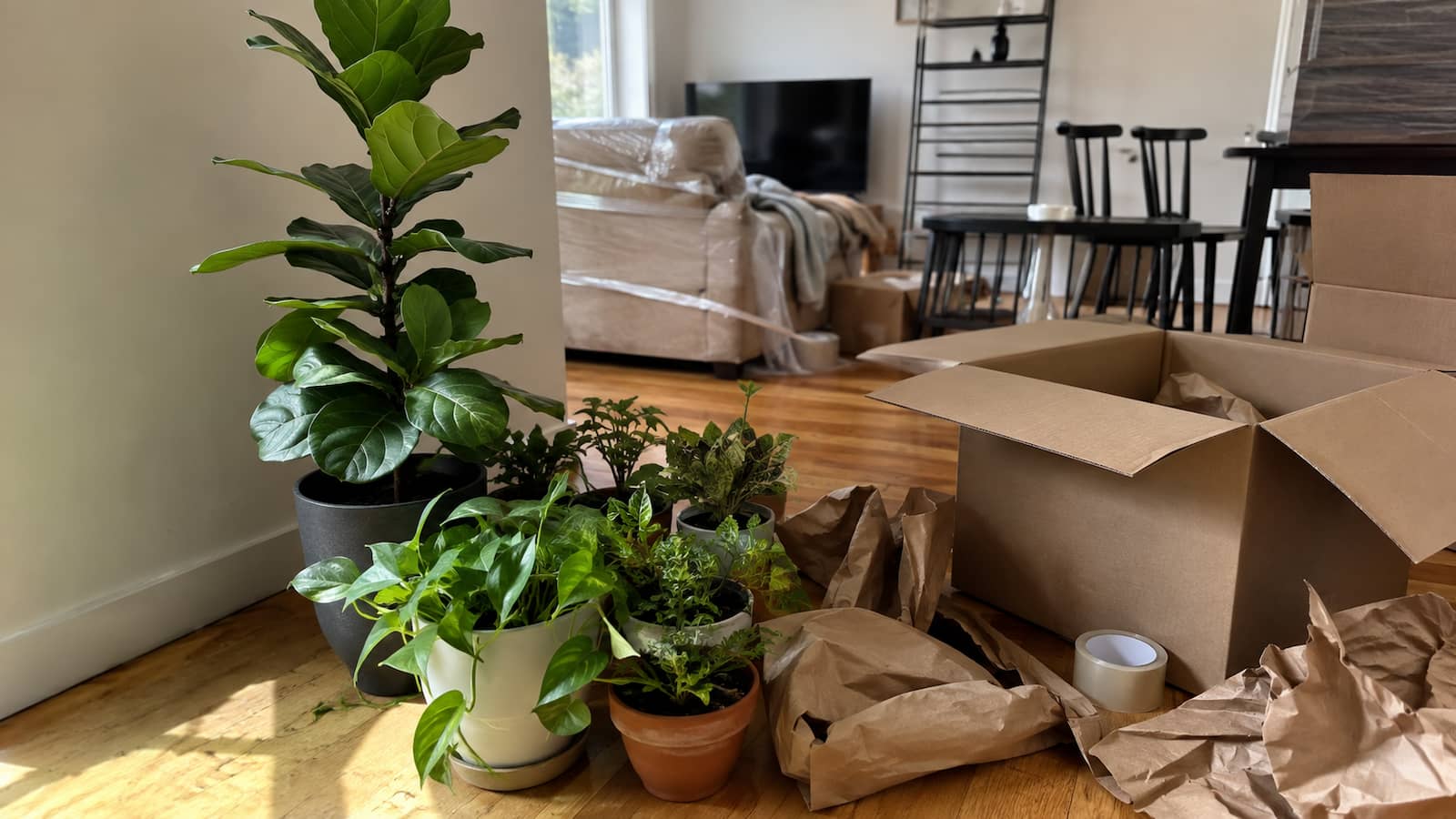

You packed the boxes, booked the truck, and then hit the question no one warns you about. What happens to the fig tree by the window, the pothos you've kept alive for years, the herbs on the balcony?
Most moving advice ignores plants entirely, or tucks them into a vague line near the bottom. That gap costs people real plants. A move that goes fine for your couch can leave your greenery crushed, dried out, or turned away at a state border.
This guide covers everything: what movers will and won't take, how to prep and pack your plants, how to keep them alive in transit, and what the law requires when you cross state lines. Start early, and most of it is manageable.
Can your moving company take houseplants across state lines?
Here's an important fact that catches a lot of people off guard late in the process: many professional movers won't put your live plants on the truck at all, especially on a long-distance move. Finding that out the week of your move is a bad time to find it out.
This is not personal, it's practical. Plants are perishable goods. The back of a moving truck isn't designed to keep anything alive. There is no light, and temperatures swing hot and cold for days. Federal guidelines on perishable items are one reason moving companies set limits here.
That's a common pattern across the industry, not a fixed rule, and it varies by company. Local moves are generally treated differently than long-distance ones, but do not assume any of it applies to your mover.
The helpful move is simple: ask your specific moving company what their live-plant policy is before you book, not after the crew arrives. Get the answer in plain language. If plants are excluded past a certain distance or time, you'll know to plan on transporting them yourself in your own car.
Move and Care is a licensed and insured moving company (USDOT #3212621; MC #1018431; NCUC #C-3067; TXDMV #009636518C; MA DPU #31854), with local and long-distance crews across the United States.
Move and Care provides written estimates with no hidden fees. Always confirm your own mover's live-plant policy before booking. For the rest of your move, you can see Move and Care's moving services.
What to do 3–4 weeks before moving day to prep your plants
Plants don't like to be shuffled around at the last minute. The work that keeps them alive happens weeks ahead, not on moving day. A simple timeline helps.
Repotting into lightweight plastic pots to cut weight
Three to four weeks before the move, if any plants live in heavy ceramic or terracotta pots, repot them into same-size lightweight plastic pots. This cuts weight, lowers breakage risk, and gives the roots time to settle before the disruption of the move. Repotting three to four weeks out means the plant isn't dealing with a new pot and a new home at the same time.
Pruning, pest checks, and your last watering before the move
One to two weeks before the move, prune off dead or damaged leaves so the plant puts energy into healthy growth, and check closely for pests. Moving an infested plant into a new home, or across a state line, only spreads the problem. This is also the point to sort which plants are actually coming with you.
Timing your last watering: Water your plants two to three days before the move — not on moving day. The goal is soil that's moist but not soaked. Watering on moving day leaves you with heavy, dripping pots and soil that spills more easily. A couple of days ahead keeps the plant hydrated without the mess.
If you're moving cross country, hold off on any fresh repotting decisions until you've checked whether your destination state requires sterile commercial potting soil — which is covered further down.
How to pack houseplants so soil doesn't spill in the car
Here's where you decide if you arrive with plants or a car full of dirt. The technique is straightforward once you know it.
Securing soil with a plastic bag or cardboard over the pot
What makes the mess is loose topsoil. To hold it in place, tie a plastic bag snugly around the base of the plant — over the soil and around the stem — or cut a piece of cardboard to fit over the top of the pot and tape it down with a slit for the stem. Either way, the soil stays in place when the pot tips or jostles on the drive.
Wrapping foliage and boxing plants for the drive
Wrap the foliage loosely in packing paper or bubble wrap to prevent branches from snapping and leaves from tearing. Loosely is the key word: you want protection, not a tight bundle that crushes the plant.
Then set each pot into a sturdy box that fits it closely so it can't slide. Fill gaps with paper to hold the pot upright, and keep the top open or loosely closed so the plant can breathe. Label the box as live plants and fragile, and always load and unload it standing upright.
If you still need boxes, tape, or packing paper, you can find packing materials and moving boxes through Move and Care. Materials like these are sold separately.
Transporting plants in your own vehicle vs. a moving truck
A dark truck bouncing down the highway for days is about the worst place a plant can be. Your own car, where you control the temperature, is the safest option by a wide margin.
Why moving-truck heat and cold kill plants
The cargo area of a moving truck has no climate control and no light. Over a long haul, it can bake in summer and freeze in winter, and even a shorter trip in the dark stresses a plant. That's the core reason to keep plants with you rather than on the truck.
In the car, keep plants out of direct sun through the windows and away from the blast of heating or A/C vents — both of which dry leaves out fast. Wedge the boxes so they stay upright and can't tip during turns and stops.
On a multi-day drive, bring the plants inside with you overnight rather than leaving them in a parked car, where temperatures climb or drop quickly once the engine is off. Give them a little light and check the soil each day.
How to move plants cross country and cross state lines legally
A long-distance move adds a layer most people never expect: plants can be inspected, restricted, or confiscated at state borders. Agricultural agencies do this to stop pests and diseases from spreading between regions, and it applies to ordinary houseplants, not just farm stock.
Rules vary widely from state to state, and they change. Some states require that plants be grown in sterile, commercial potting soil rather than garden dirt, since native soil can carry pests. Some restrict particular species outright. A few plants may need a phytosanitary certificate — an official document confirming the plant was inspected and found pest-free.
Because these rules shift and differ everywhere, the reliable step is to check your destination state's current requirements before you pack, not after. The National Plant Board keeps a hub for state plant transportation laws and regulations.
State border inspections and sterile-soil rules (California example)
California is a strong example of how serious this gets. The state runs border inspection stations and has California's strict houseplant import guidelines on what plants can enter and under what conditions, including requirements around soil.
Treat California as a reminder that "it's just a houseplant" isn't a safe assumption. Check the specific state you're moving to.
USDA Spongy Moth quarantine rules for outdoor plants
Beyond state rules, there's a federal one that catches people moving outdoor items. The USDA enforces the USDA Spongy Moth quarantine guidelines covering certain regions, and if you're moving out of a quarantined area, outdoor plants, pots, and related items may need to be inspected and certified as pest-free before they can go.
Quarantine boundaries change, so check the current map for your origin region rather than relying on an old list.
How to move large, heavy, and tall potted plants
Moving a large floor plant is a quick way to strain your back and smash a pot. Because size complicates everything, plan the handling before you ever pick it up.
Start by cutting the weight where you can. If a large plant is in a heavy pot, repot it into lightweight plastic a few weeks ahead — as covered earlier — so you're not wrestling ceramic on moving day.
For tall plants, support the trunk or main stem so it doesn't whip around and snap. You can loosely tie the branches inward and wrap the whole canopy in paper to keep it compact and protected during loading. Keep the pot base stable so the plant can't tip.
When it's time to move it, use a sturdy box or a dolly rather than carrying by the stem, and get a second person for anything awkward or heavy. Lift from the pot and base, not the plant itself, and keep it upright the whole way to the car.
How to dig up and move outdoor garden plants
You can bring a beloved shrub or perennial from your yard, but a plant yanked from the ground rarely recovers if you rush it. The roots are everything.
Water the plant well the day before you dig, so the soil holds together and the roots aren't already stressed. Then dig a wide circle around the base to keep as much of the root ball intact as you can, rather than cutting in close and shearing the roots off.
Once it's out, wrap the root ball in burlap, a bag, or damp material to hold the soil around the roots and keep them from drying during transport. Keep it moist and get the plant back in the ground reasonably soon at the new place.
One more thing that's easy to forget: the border and quarantine rules above apply to outdoor plants too, and outdoor items are exactly what the Spongy Moth quarantine targets. Check before you dig if you're crossing state lines.
Which plants to move, propagate, or leave behind
Some plants just aren't worth the trip, and deciding early saves you effort, money, and heartbreak. Run each plant through a few honest questions.
-
A small pot travels easily. A six-foot tree in a heavy planter is a real project. Weigh the hassle against how much the plant means to you.
-
Is it sentimental or hard to replace, or is it a common plant you could rebuy cheaply at the new place? Replacing an easy plant may beat hauling it across the country.
-
If the plant or its soil is restricted in the state you're moving to, that may settle the question for you.
-
Some plants shrug off a move; others sulk badly. Fragile or fussy plants may not be worth the gamble on a long haul.
For big plants you'd rather not move whole, propagation is a great middle path — snip off a few cuttings, pack them light, and grow them fresh at the new home. And for anything you can't take, rehome it with friends, neighbors, or a local drop-off so it gets a second life instead of the curb.
Settling plants into your new home and easing transplant shock
Arriving doesn't mean the move is finished. The first few days in the new place decide whether your plants bounce back or keep declining.
Unpack your plants first, before the furniture marathon takes over. Get them out of their boxes, unwrap the foliage, and give them water and light. The sooner they're out of transit conditions, the better.
Expect some stress. Yellowing or dropped leaves after a move are common and don't automatically mean the plant is dying. Give it time to adjust before you make any changes.
Ease plants into their new light rather than dropping a plant that lived in bright light straight into a dim corner, or vice versa. Move them toward their ideal spot gradually over a week or two so they can acclimate. Steady care beats overreacting.
Once your plants are riding safely in your own car, let Move and Care handle the rest of the move — request a free moving estimate.




