


One of the most crucial documents you will receive on moving day is the moving bill of lading. This is your contract for the move and your receipt for the items your mover is taking into their care. The Federal Motor Carrier Safety Administration states it plainly for an interstate household move:
“The bill of lading is the contract between you and the mover.”
It’s that single statement that makes this text worth reading closely. The bill of lading ties together your estimate, order for service, moving inventory sheet, payment conditions, delivery details and liability coverage. If there is a billing issue, missing item, damaged furniture or claim after delivery, this paper will be part of the record.
For homeowners with hardwood floors, the bill of lading is also a reminder to slow down before the loading begins. While the document focuses mostly on the shipment, moving day might impact more than what’s on the truck. Heavy furniture, appliances, dollies and pointed furniture legs can scratch beautiful wood floors therefore sufficient protection should be used by the team. Before you sign, read the moving paperwork and your home's protection plan.
Move-day tip: Don't pack your bill of lading, estimate, inventory sheet or order for service in a box. Retain these records until your items are delivered and charges are paid and any dispute is handled.
What a moving bill of lading does

The bill of lading has two primary functions. First, it operates as the moving contract. Second, it serves as a receipt for the shipment itself. It should tell you who is moving your household goods, where they’re being picked up, where they’re being delivered, how the move is being charged, and what liability option is in effect if something is lost or damaged.
The FMCSA says the mover must have a bill of lading for each shipment it moves, and the driver must give the customer a copy before or when the shipment is loaded. It further states that the consumer shall study and understand the bill of lading before signing. You can review the official rule in the FMCSA guidance to pickup documentation and the bill of lading.
In plain English: don’t take the bill of lading as ordinary paperwork. If there is an error in the addresses, dates, charges, valuation choice, or associated inventory, ask to have it corrected before the truck is loaded.
Bill of lading vs. estimate vs. order for service
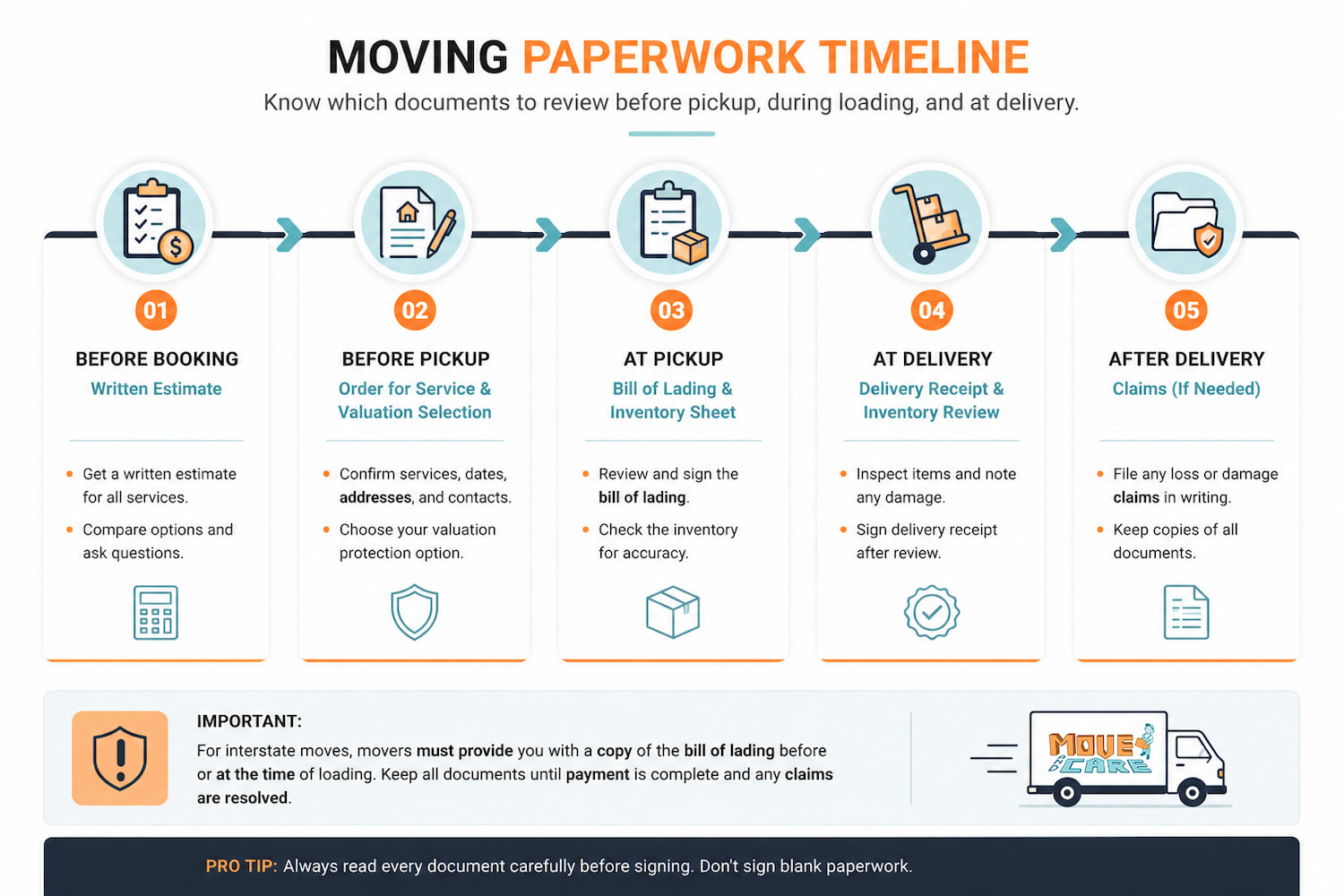
The process of moving documents could appear repetitious, yet each page serves a different purpose. The written estimate does specify the estimated charges. The order for service confirms the requested services. The contract used during pickup becomes the moving bill of lading. The inventory sheet describes what is being transferred and how it looks.
| Document | What it does | When to review it |
|---|---|---|
| Written estimate | Shows expected moving charges, requested services, and valuation options. | Before booking and again before moving day. |
| Order for service | Confirms the move details, dates, addresses, and services the mover agreed to provide. | Before pickup. |
| Bill of lading | Acts as the contract and shipment receipt when the mover takes possession of your goods. | Before or at loading, before you sign. |
| Moving inventory sheet | Lists items loaded and notes visible damage or unusual wear. | During loading and again at delivery. |
The estimate must be in writing. The FMCSA recommends that clients not accept oral estimates and that the estimate fully specify all charges for services the mover will provide. This is detailed in its tips for a successful move.
What should be included on a moving bill of lading?
Your service order should contain the important information for your bill of lading. It should have the name and address of the mover, names of participating carriers, the contact office of the mover, pick-up and delivery information, agreed payment method, payment conditions and the charges or maximum amount payable upon delivery where applicable.
It should also reflect the valuation option selected. Valuation is not the same as the mover’s business insurance. It is the amount of responsibility the mover takes on for your belongings if they are lost or destroyed. For transfers across state lines, movers must offer Full Value Protection and Released Value Protection. Both possibilities are described in the FMCSA’s guide to liability and valuation coverage.
Released Value Protection is normally free but provides limited protection, no more than 60 cents per pound per object. That can be well under the genuine value of furniture, electronics, antiques or custom pieces. The broader coverage is Full Value Protection, however the cost and deductible may differ by mover. Get the details in writing before move day.
Why the moving inventory sheet matters
The moving inventory sheet is closely related to the bill of lading. It details what was loaded by the mover and notes any evident damage or unusual wear. If the mover prepares the inventory, it can be incorporated into the contract of the bill of lading.
Walk through the inventory with the crew. If there is a scratch on a dresser, be sure the notation is right. If a chair is marked as damaged but it is not, ask for correction. If you’re moving a table, cabinet or appliance across hardwood flooring, check how it will be lifted, carried or protected. A moving inventory sheet safeguards the shipment; images and notes can assist protect the condition record of your home.
Check the inventory sheet against what you get on delivery. Mark any missing boxes, damaged boxes, or any new damage to furniture on the delivery papers prior to signing. The FMCSA’s moving checklist advises customers to mark any boxes and things that are damaged or missing on the inventory list before signing delivery paperwork.
Mover paperwork checklist before pickup

Check your documents in a single spot before loading begins. Here are several faults that can still be swiftly remedied.
Documents to have ready
Keep with you your documented estimate, order for service, bill of lading, moving inventory sheet, valuation selection, mover contact data and delivery contact info. For an interstate move, also be sure the mover is registered with FMCSA and has a U.S. DOT number. FMCSA’s Protect Your Move page describes your rights and obligations and the documentation used in interstate movements.
Home protection to confirm
If you have hardwood floors, finished stairs, narrow corridors or a new floor in your home, enquire how they will safeguard such surfaces. Floor runners, clean masonite panels, furniture pads and careful lifting can avoid scratches. Never move heavy furniture or appliances across a finished wood surface.
Red flags before you sign
Some missing information can be common if final cargo weight or final charges are not yet known. But the fundamental terms must still be obvious. Use the list below to decide when to stop and ask questions.
-
Do not sign a blank piece of paper. You should be given enough information to know what you are agreeing to: the legal name of the mover, contact information, pickup specifics, delivery details, payment conditions and your valuation choice.
-
Ask why the numbers are different before you start loading. Other services, access issues or packing services should be described and documented.
-
Make sure you know if you chose Full Value Protection or Released Value Protection. Released value offers little protection, it is calculated by item weight, not real replacement value.
-
You are responsible to read and comprehend the bill of lading before signing. A pro mover should allow you time to look it over.
-
If you’re moving interstate, the driver should provide you a copy before or when they load your goods. Keep it available until delivery, payment and any claim have been settled.
What to do on delivery day
Delivery day is the second key checkpoint for your papers. Keep the bill of lading and inventory sheet close to hand. Compare products coming off the truck with inventory. Look for missing boxes, shattered cartons, broken furniture or new scratches.
If the residence has hardwood flooring, stick around while heavy items are being put down. Require movers to use floor protection and proper lifting techniques. Metal furniture feet, appliance edges and loaded dollies can easily leave a mark. Clean protective materials are important; grit can get beneath a runner or board and still harm a finished floor.
If any of your possessions are damaged, note it on the inventory or delivery documentation before you sign. If there is any damage to flooring, walls, stairs or doors, picture it and inform the mover following the claim process outlined in your documentation. The FMCSA says consumers have nine months from delivery to make a written claim for loss or damage, but the safer option is to report problems early.
Local moves and interstate moves may have different rules
FMCSA regulations apply to interstate household goods shipments. If your move is inside one state, state rules may be applicable instead. But the practical processes are the same: Get the papers in writing, read it before signing, preserve copies, verify valuation or liability terms, examine the inventory upon delivery, and immediately document any damage.
If you are scheduling a local move, ask the moving firm what papers you will get and what state restrictions apply. A good mover will explain all the documentation clearly before moving day.
Final takeaway
A moving bill of lading only protects you if you read it and understand it and preserve a copy. It should correspond to your estimate and order for service, display shipment details and payment conditions prominently, and link to the moving inventory page. Review the essentials, valuation coverage, verify the inventory, and ask questions on anything that looks incomplete or different than what you agreed to before signing.
To help your relocation go more smoothly, request a estimate in writing, find out what paperwork will be provided and establish how your furniture, valuables and finished surfaces will be protected before loading begins.
FAQ
For interstate household goods relocation, the mover must prepare a bill of lading for each shipment that it transports. The driver will provide you a copy before or at the time of loading.
Read the document, confirm that the key details are correct and then sign this. If charges, dates, locations, valuation coverage or inventory look inaccurate, ask for revisions first.
It can be so. The inventory prepared by the mover may be attached to the contract of the bill of lading. That’s why you should always read item descriptions and condition notes before you sign.
The estimate reflects projected charges. When the mover picks up your items, the bill of lading is the moving contract and shipment receipt. The two documents should not be contradictory.
Check inventory or delivery documents for missing or damaged items before you sign. Take pictures, save your bill of lading, and follow the mover’s formal claim process. FMCSA says written claims must be filed within nine months following delivery for interstate moves.
Hold on to it until all costs are paid, your items are delivered and any claims are settled. Do not put it in a moving box.




